Behind the Buy: Here’s How Using Concreteness Will Help You Sell More Tickets

Picture it.
It's Thursday night. A busy, working mom with a 12 and 14 year-old is scrolling, looking for something to do that weekend. She's worried her kids are too glued to screens and she's hoping for a chance to too not think about what’s happening at her law firm.
Two very different shows pop up on Claude.
Org #1: The combo of ballet, jazz, and modern pop with colorful costumes is visually stunning and funny — perfect for the entire family.
Org #2: This Saturday, your tween will discover how some of the most famous classical pieces by Beethoven and Mozart make it into movies like Indiana Jones and Batman — all performed live by a full orchestra. It's the perfect bridge between family concerts and full-length performances. And yes, you might actually get some quiet time.
Mom thinks: "The kids will learn something new, and if it grabs them, I'll actually get to watch too."
The second organization used concreteness.
It worked because mom could picture exactly what she was getting.
Why concreteness works
Concreteness is rooted in the Construal Level Theory of Psychological Distance, research by psychologists Yaacov Trope and Nira Liberman.
The short version: when a product or service feels far away in time, distance, or likelihood people are less likely to act because they think about it as an idea or abstract concept.
When that product or service feels close and specific, people are more likely to engage — especially if it feels relevent to them.
This is part of why audiences wait until the last minute to buy tickets. A show three months away feels like a someday plan, not a Saturday night save-me-from-boredom solution.
The more vividly someone can picture what they're getting, the more likely they are to buy.
Some of the most effective advertising campaigns ever made were built on this idea.
Apple's "1,000 songs in your pocket" outsold Philips' "128 MB storage" because people could picture 1,000 songs.
Oreos tested "15 cookies in a pack" against "150 grams" and the number of cookies won.
M&M's "Melts in your mouth, not in your hand" works on two senses at once.
FedEx didn't promise "reliable delivery" they said "when it absolutely, positively has to be there overnight."
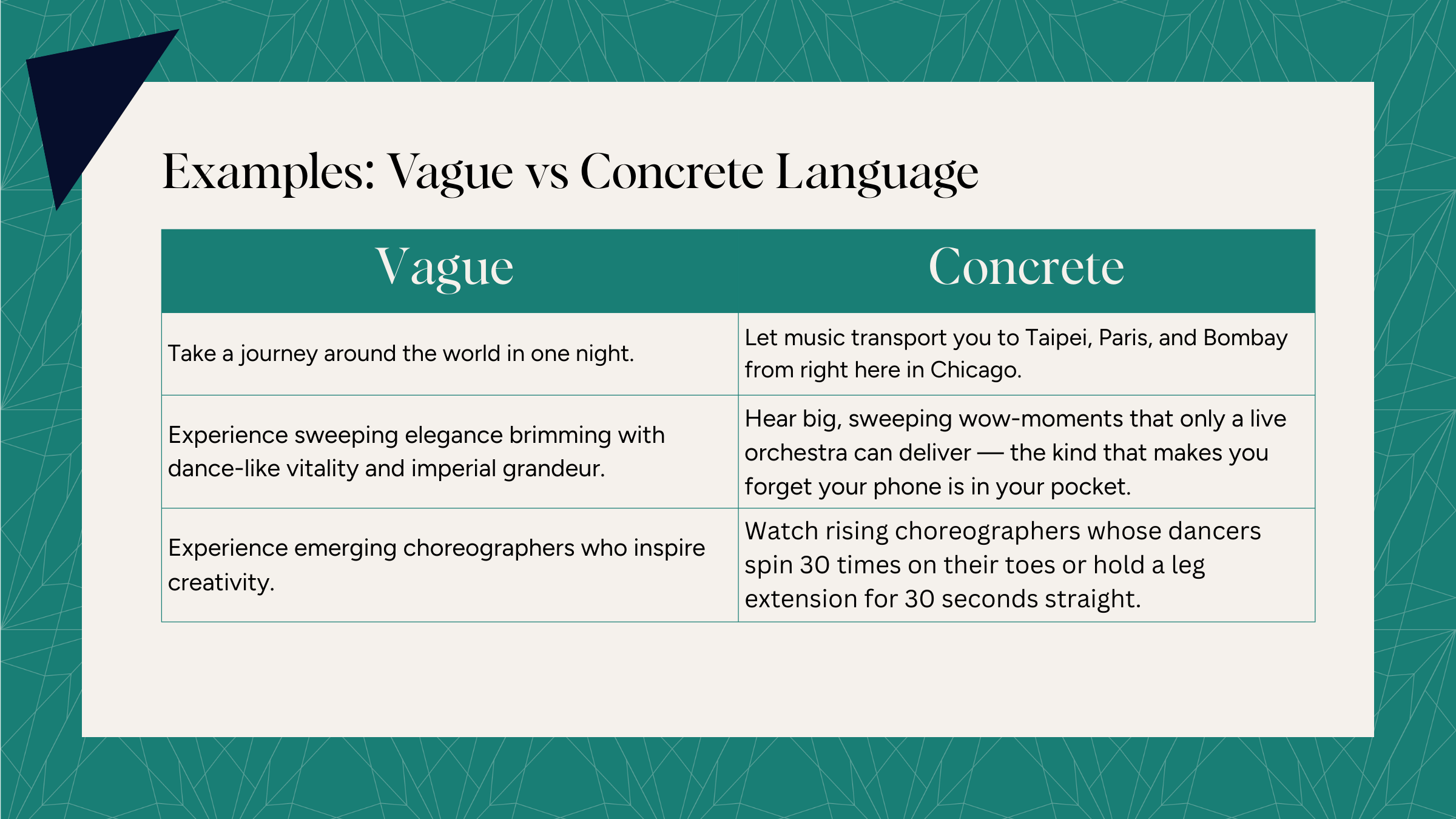
Arts organization marketing is usually full of the opposite.
Here's what that looks like side by side:
You can use concreteness to improve your leadership skills, too.
You've probably been in this situation. You assign a project with vague direction, no clear parameters, and a vague deadline. Your colleague slowly cobbles something together. A few weeks, you’re redoing it from scratch because that’s not what you were looking for.
Researchers tested exactly this. Across three experiments, the way a task was described changed when people actually completed it. Participants given concrete, specific framing finished significantly sooner than those given abstract framing. Same task. Same deadline. Same reward. The framing moved people to act better and faster.
One experiment made this even more vivid. Researchers primed concrete versus abstract thinking using a painting. One group saw a close-up showing individual dots of color. The other saw the full painting described in terms of mood and harmony. Then both groups completed the same unrelated task. The concrete-primed group still responded sooner.
Abstract language signals: this belongs in the future. Concrete language signals: this belongs right now.
For leaders, this means choosing one of two clear paths. Either say: "I know I want a new membership program with online ticket redemption. Please figure the rest out.” Or say: "I need to focus on the season announcement and need you to own this from scratch."
What doesn't work is leaving your team to guess, then redoing their work when they guess wrong.
Concrete direction protects your team's time. It also gets things done faster.
The Short of It
People act faster when they can picture what you're asking them to do. Vague copy and vague direction both have the same effect: delay.
Pick one piece of copy or directions for a project this week. Find the vague phrase. Replace it with something a person can see, hear, or feel and see what happens.
Sources:
Trope, Y., & Liberman, N. (2010). Construal-level theory of psychological distance. Psychological Review, 117(2), 440–463. https://doi.org/10.1037/a0018963
Liberman, N., Trope, Y., & Wakslak, C. (2007). Construal level theory and consumer behavior. Journal of Consumer Psychology, 17(2), 113–117.
McCrea, S. M., Liberman, N., Trope, Y., & Sherman, S. J. (2008). Construal level and procrastination. Psychological Science, 19(12), 1308–1314.
Shotton, R., & Flicker, M. (2026, January–February). The marketing genius behind the best brands. Entrepreneur.(Adapted from Shotton, R., & Flicker, M. (2025). Hacking the human mind: The behavioral science secrets behind 17 of the world's best brands. Harriman House.)
Agnew, P & Bourgoin, K. Wallet-Opening Words.
Photo by Ahmad Odeh on Unsplash
