Behind the Buy: Your Pricing Psychology Cheat Sheet
Ticket prices are a puzzle.
In fact, pricing strategy might be the hardest part of arts marketing and audience building.
Some organizations set prices with layers of spreadsheets and no real story to back them up.
Others go entirely on their gut with a mix of fear, and hunches.
Nearly everyone brings their personal, complicated feelings about money to the table.
Add inflation (real or perceived) and the sense that the future is shaky, and it’s no wonder even the smartest teams second-guess every dollar sign.
When audiences cite “price” as a logical barrier to attending a performance, they’re rarely talking about the number.
People will make wildly irresponsible financial decisions if they really want something.
They’re talking about what the price means to them in terms of value.
And how you talk about your ticket prices affects how people see the value of the performance
Let’s look at a few ways to make those numbers feel different.
The Basics
You’re already doing this, but could make it more effective.
Scarcity
“Limited availability!” “Sure to sell out!”
People want what feels scarce because scarcity triggers emotion — a mix of competition, pride, and the relief of not missing out.
In fact, researchers at the University of Virginia and UNC proved it decades ago with the cookie-jar experiment.
The same type of cookies were placed in two jars. One only had two cooks, the other was nearly full. People rated the cookies from the nearly empty jar as higher quality.
👉 FYI: scarcity grabs people’s attention, but fake scarcity leaves a bad aftertaste. If you’ve got plenty of seats, focus on why this performance is special, not how few tickets are left.
Urgency
We often put deadlines on all our deals and sales. But a 1997 study tested time limits (“offer expires soon”) and quantity limits alongside discounts.
At steep discounts, restrictions increased purchases.
Purchases decreased when small discounts were offered alongside deadlines. This route actually eroded trust because people felt manipulated.
In other words, timers make good deals look better and weak deals look desperate.
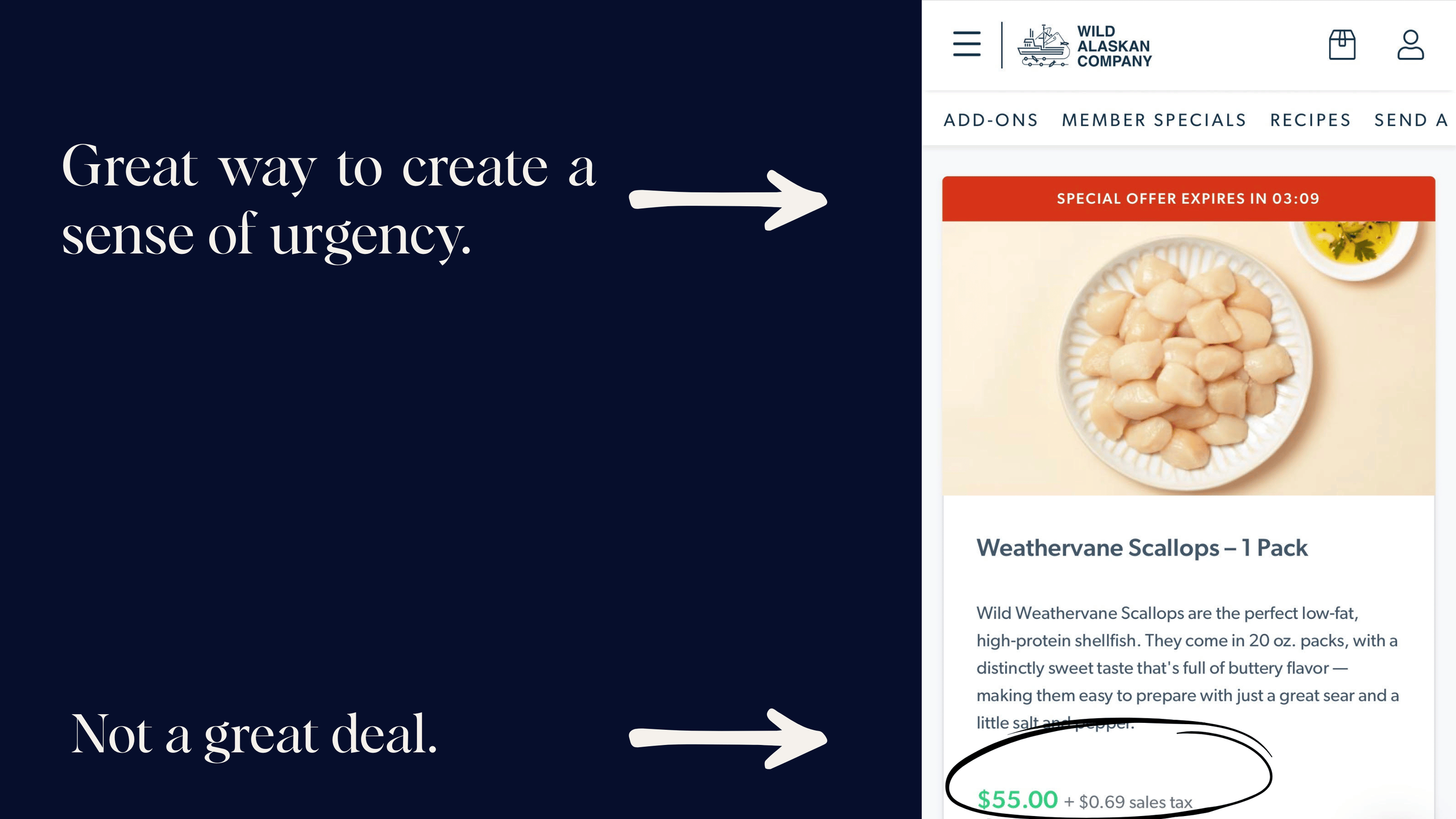
Example: Wild Alaskan almost got me to add scallops to my purchase — if I purchased within five minutes. I almost immediately added them to my cart, but decided to price compare. Once I saw that this wasn’t a great deal, I realized that this wasn’t really deal and ditched the scallops.
If you’re running a flash sale, make the reason believable: “Prices go up Monday when the orchestra moves into final rehearsal” lands better than “Hurry, here’s a 10% discount. Time’s running out.”
Exclusivity
We have exclusivity down for subscribers and donors so well that many casual attenders feel intimidated to attend a show.
It’s important that we listen to our entire audience to:
Figure out how to make casual attenders feel like they’re a part of the club — even if they’re not ready to or can’t subscribe.
Take the time to listen to subscribers and donors to learn what benefits they actually value.
Going Deeper
Ways that can make people more likely to buy that ticket or upgrade.
Framing
Framing is packaging information so your audience sees it through a lens that favors your point.
In the case of pricing, you’re presenting them in a way that highlights a positive difference or a perceived “deal.”
A quick scan through my email showed that almost no arts organizations are using framing when it comes to pricing.
Examples:
List the price difference and specific benefit for upgrading: "Get a backstage pass for only $20 more."
Anchoring the Price: The first price people see sets the tone. Show the highest price first to make the rest of the prices feel like a smart buy.
Compare to Every Day Choices: Two burgers and beers in a loud bar now costs about the same as two tickets to live music you’ll remember all year.
Goal Gradient Effect
The Goal Gradient Effect has been around since the 1930s, when psychologist Clark Hull noticed that rats in a maze ran faster as they got closer to the food.
We work harder and faster as we get closer to a goal we want to achieve.
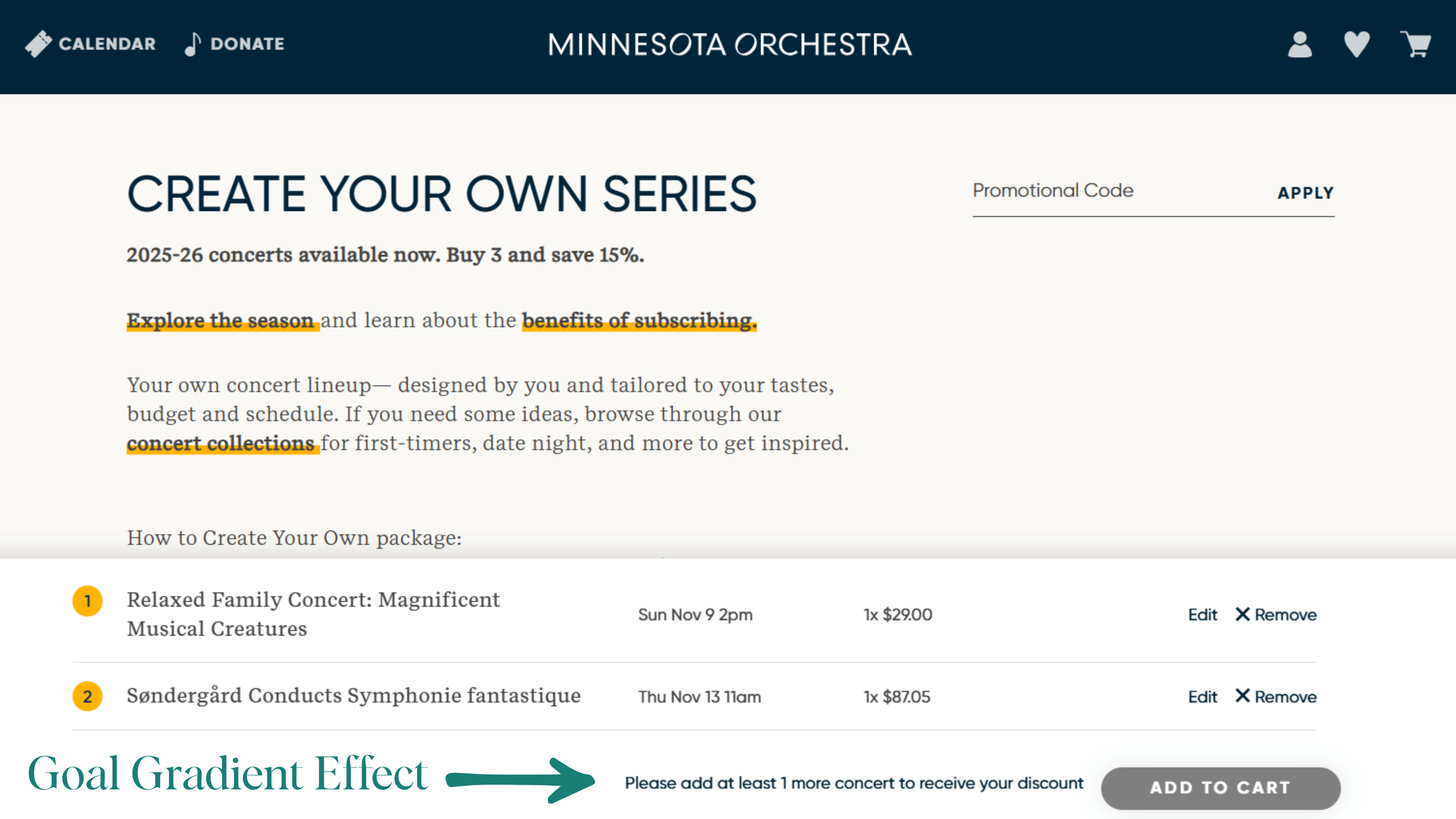
You can see this at work in the Minnesota Orchestra’s Create Your Own cart. As someone adds concerts, the incentive to add that last concert and get a discount grows.
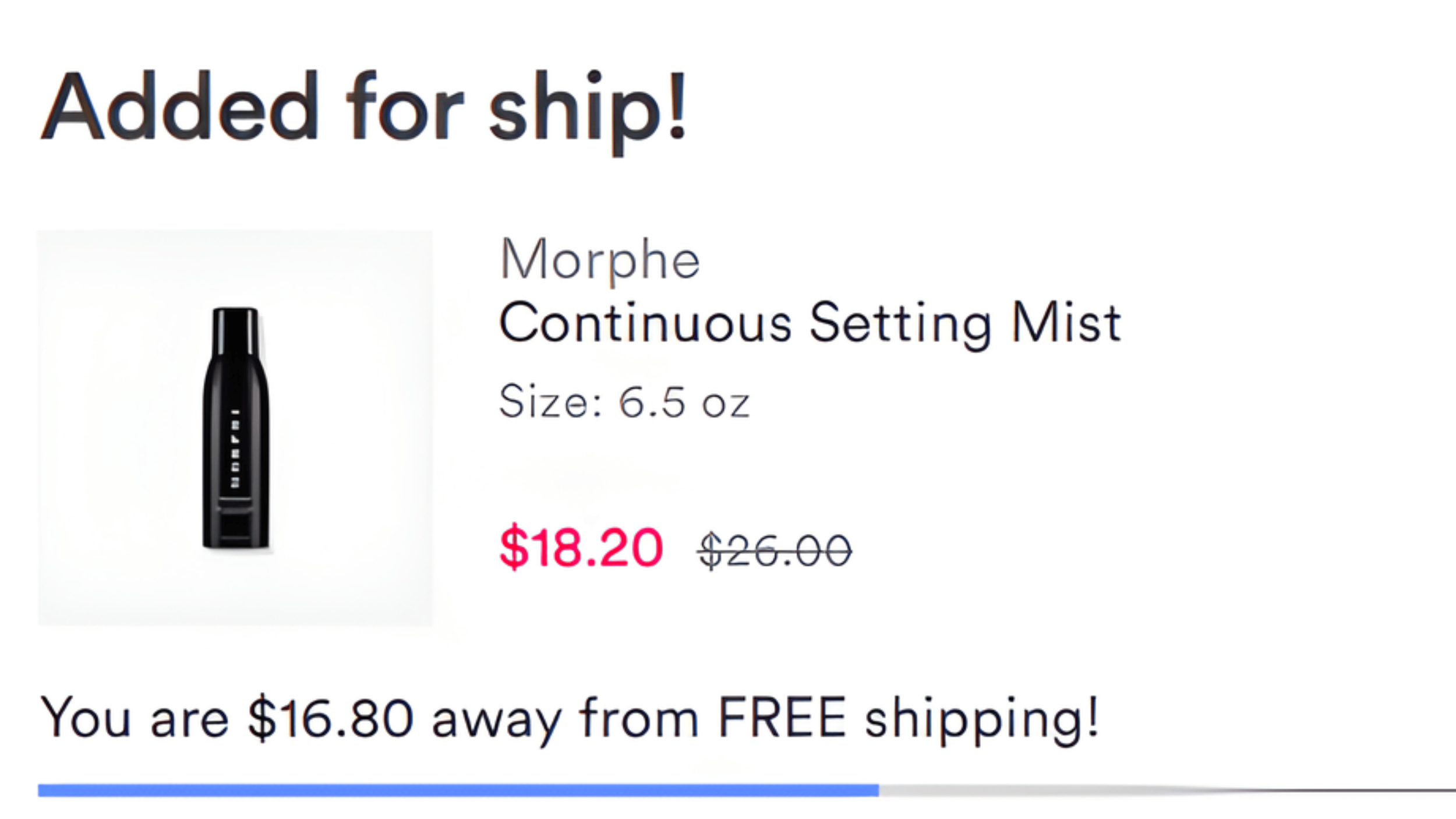
Retail companies like Ulta go a few steps further with a progress bar that shows you exactly how much you need to spend before they waive the shipping fee — because people will happily spend way more to avoid a fee.
Goldilocks Effect (or the Decoy Effect)
Back in 1982, researchers Joel Huber, John Payne, and Christopher Puto ran a series of experiments that changed how we thought we knew about how people make choices.
They discovered that when you add a slightly worse version of a product to a lineup — something that’s clearly inferior to one option but not to another — it can actually nudge people toward the better one.
Software as a Service (SaaS) companies use the Goldilocks Effect as standard practice, and it’s likely why subscriptions have become such a popular pricing model over the last decade.
Your Typical SaaS Subscription Pricing Page
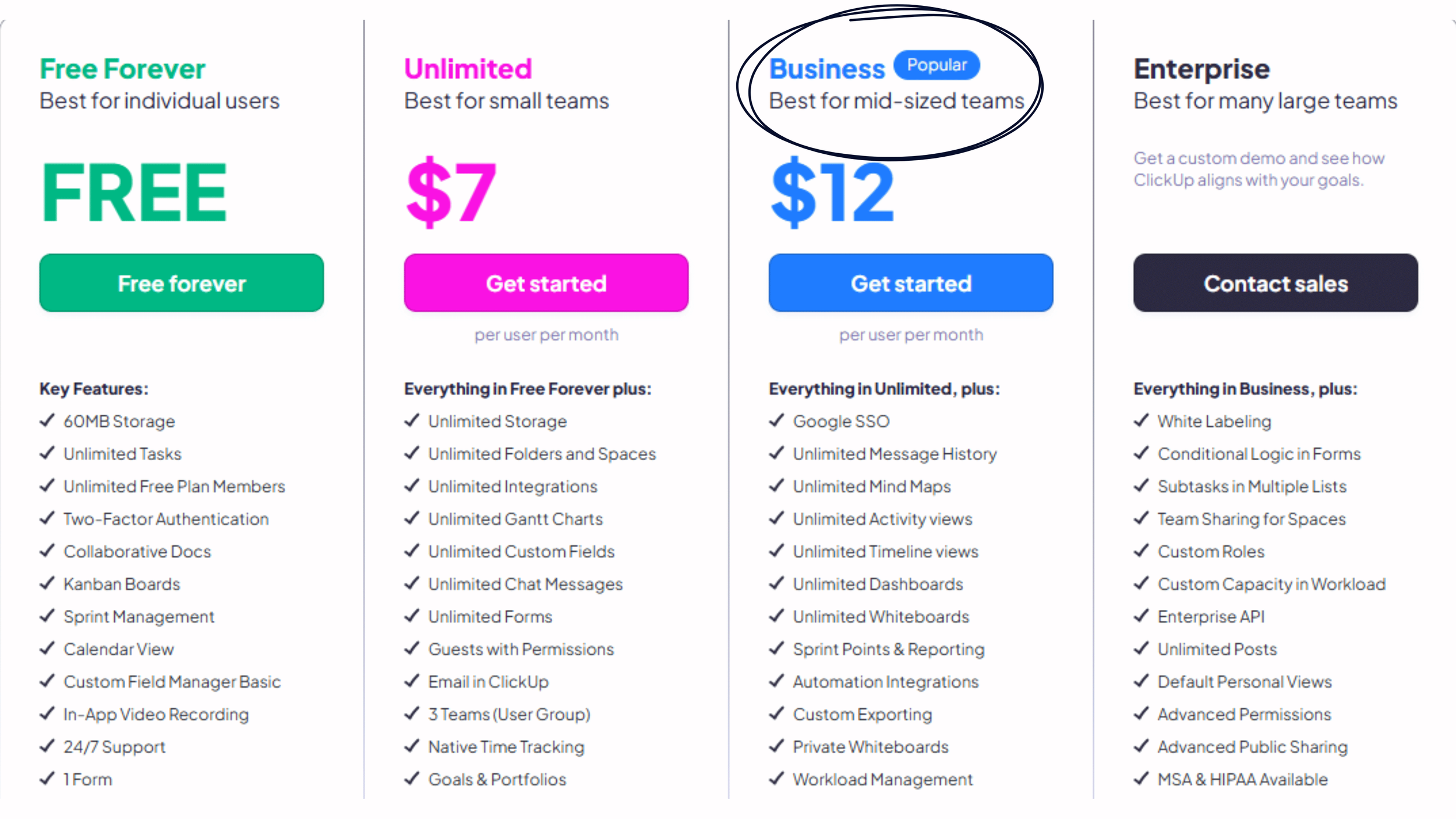
On the other hand, arts orgs list tons of packages and options, slowing down a purchase decision or shutting it down all together.
Subscription Sales Page at an Arts Org
Social Proof
When people are unsure what to do, they look to others like them (not a critic).
Social proof is wildly underused at arts organiations.
Many arts orgs see this as a testimonial video or maybe adding quotes somewhere on the landing page.
People are also more likely to copy behavior when it feels like that’s what everyone else is already doing.
A UK study tested a few anti-litter signs and found that “9 out of 10 people use a bin” worked best. Using the language “1 out of 10 people litter” or warnings about £150 fines were not effective.

Behaviour Change Cornwall: https://behaviourchangecornwall.co.uk/signs-to-stop-plastic/
Try using language like this:
2,000 Chicagoans subscribe to the ballet.
4/5 audience members said they loved Ravel’s Daphnis and Chloé.
Most of our audience saw Wicked.
95% of our audience are giving five stars.
The Short of It
Pricing will never be easy because it sits at the intersection of math, mission, and emotion.
Your audience wants to feel confident that they’re spending wisely and getting something valuable in return.
Making tiny tweaks can inspire action to complete the purchase and potentially change a life.
Did you like what you read?
Join other smart arts leaders for a pitch-free Executive Roundtable Discussion: What’s Your Game Plan for Smarter Ticket Prices? Your seat is valued at $150, but always on me (see what I did there?).
Wednesday, December 10 | 12-1PM
Save your seat.
Sources
Scarcity: Aggarwal, Jun, & Huh (2011) – “Scarcity Messages: A Consumer Competition Perspective” (Journal of Advertising)
Scarcity: Harhut, Nancy. Behavioral Science in Marketing: Understand Your Customers, Influence Their Behavior, and Drive Better Results. New York: Routledge, 2022.
Urgency: Inman, J. J., Peter, A. C., & Raghubir, P. (1997). Framing the deal: The role of restrictions in accentuating deal value. Journal of Consumer Research, 24(1), 68–79. https://doi.org/10.1086/209493
Goal Gradient Effect: Kivetz, R., Urminsky, O., & Zheng, Y. (2006). The goal-gradient hypothesis resurrected: Purchase acceleration, illusionary goal progress, and customer retention. Journal of Marketing Research, 43(1), 39–58. https://doi.org/10.1509/jmkr.43.1.39
Goldilocks Effect: Huber, J., Payne, J. W., & Puto, C. (1982). Adding Asymmetrically Dominated Alternatives: Violations of Regularity and the Similarity Hypothesis. Journal of Consumer Research, 9(1), 90–98. https://doi.org/10.1086/208899
Social Proof: Refill UK. “Don’t Be a Tsser: How to Reduce Littering with Effective Signage.” 2021. https://www.refill.org.uk/dont-be-a-tsser-how-to-reduce-littering-with-effective-signage/.
